
Rock Sliders for the Land Cruiser: What to Know
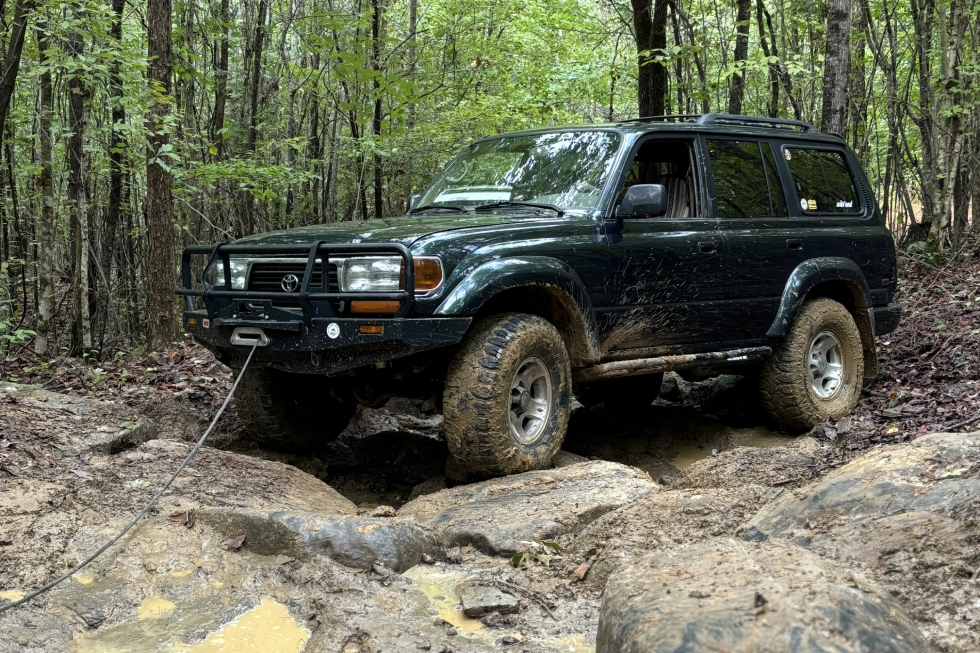
What they do, why frame-mounting matters, and what to look for.
Rock sliders don’t get the attention that a lift kit or a winch does. They’re not the flashiest modification you can make to a Land Cruiser. But on a truck that’s going to see any real off-road use, they’re one of the most practical and most protective things you can add.
Most owners who skipped sliders find out they needed them at the worst possible time. A ledge drop they didn’t see coming, an off-camber section that pushed the truck sideways, a trail obstacle that looked manageable until it wasn’t. The rocker panel connects with rock or a ledge, and what would have been a non-event becomes a body repair.
This post covers what rock sliders actually do, what separates a good slider from a cheap one, and what the installation looks like on a 100 Series.
Key Takeaways:
- Rock sliders protect the rocker panels, the most vulnerable body area on a Land Cruiser in off-road use.
- Frame-mounted sliders are structurally different from body-mounted sliders. Only one does the job under real load.
- Material and welding quality matter. A slider that bends or pulls free on trail is worse than no slider.
- Sliders work at stock ride height and get more effective with a lift.
- OTM fabricates sliders in-house. The result is built to the truck, not off a shelf.
What Rock Sliders Actually Do
The rocker panels on a Land Cruiser are the lower body panels that run along the sides of the truck between the front and rear wheel wells. They stick out past the frame on both sides. On trail, they’re the lowest and most exposed part of the body structure.
When a truck tips slightly on a side slope, or when it slides sideways into an obstacle, or when it drops off a ledge at an unexpected angle, the rocker panel is the first point of contact. Without sliders, that contact bends sheet metal. The repair is bodywork, which is labor-intensive and expensive. Depending on the severity, it can also affect the structural integrity of the door opening and the surrounding panels.
Rock sliders intercept that contact. A properly built slider takes the hit and either rolls the truck back onto a level surface or at minimum takes the structural punishment so the body doesn’t have to. After a significant hit, a bent or scratched slider is a good outcome. That’s what they’re designed for.
What are rock sliders on a Land Cruiser? Rock sliders are steel tubes or plates that mount along the lower sides of the truck, between the front and rear wheels, to protect the rocker panels from contact with rocks, ledges, and uneven terrain. A properly built and mounted slider can take the weight of the vehicle without failing.
Do I need rock sliders if I only do easy trails? The case for sliders gets stronger as trails get harder, but even on moderate terrain the rocker panels are exposed to contact that builds up over time. Sliders protect the resale value of the truck in addition to protecting the body on trail. They’re worth having on any Land Cruiser that leaves pavement regularly.
Frame-Mount vs. Body-Mount: Why It Matters
This is the most important distinction to understand when shopping for sliders.
Body-mounted sliders bolt to the body of the truck rather than the frame. From a distance, they can look similar to frame-mounted sliders. The price is often lower. But they cannot handle the same load.
When a truck slides onto a rock or drops a wheel off a ledge and the slider takes the weight of the vehicle, that load has to transfer somewhere. On a frame-mounted slider, the load goes through the mounting brackets directly into the frame rails. The frame is built to handle that stress. The truck can rock off the obstacle and drive away.
On a body-mounted slider, that same load transfers into the body panels. Sheet metal floor and rocker structures are not designed to bear the weight of a 5,500-pound truck pressing down on a single contact point. The mounting points can pull through the floor. The slider can peel away from the body. At best you have a wrecked slider. At worst you’ve done structural damage to the body while also losing the protection the slider was supposed to provide.
If you’re putting sliders on a truck you plan to use, spend the money on frame-mounted sliders. The price difference is worth it the first time the sliders do their job.
What is the difference between frame-mounted and body-mounted rock sliders? Frame-mounted sliders transfer load from the slider through mounting brackets directly into the vehicle’s frame rails. Body-mounted sliders transfer load into the body panels. Under the kind of stress that rock sliders are designed to handle, frame-mounted sliders perform significantly better. Body-mounted sliders can pull free or cause body damage under heavy side load.
What We Build at OTM
We fabricate rock sliders in-house at the Leeds shop. That’s not the norm. Most shops buy sliders from an aftermarket supplier and bolt them on. We build them here because we can control the material, the mounting geometry, and the fit to the specific truck on the lift.
Our sliders are DOM steel tube, which is a drawn-over-mandrel tube with consistent wall thickness that’s appropriate for structural applications. We weld the mounting brackets, test the fit against the frame, and build the step geometry into the slider so it’s usable for getting in and out of the truck as well as functional on trail.
Building in-house means the slider fits the truck rather than fitting a general template. The mounting points hit the frame correctly. The height and width are dialed in for the specific suspension setup on the truck. That matters more than it sounds when you’re trying to get the most protection out of the component.
Are aftermarket rock sliders as good as custom-fabricated sliders? Quality varies significantly in the aftermarket. Some aftermarket sliders use appropriate materials and frame-mount correctly. Others use lighter tubing and compromise on the mounting system to reduce cost. Custom-fabricated sliders built to a specific truck give you control over material, mounting geometry, and fitment that you don’t always get with an off-the-shelf option.
Installation and What to Expect
Installing frame-mounted sliders involves removing the factory side steps or running boards if present, drilling or cutting access points to reach the frame mounting locations, welding or bolting the mounting brackets to the frame, and fitting the slider assembly. Depending on the design, some installations also involve body work around the rocker panel area to route the slider correctly.
At OTM, a slider installation is a shop day. We fit the truck on the lift, confirm the mounting points, and install the sliders so the geometry is right and the mounting is solid. After installation we confirm clearance with the suspension at various points in the travel range to make sure there’s no contact during normal articulation.
The truck leaves with sliders that are mounted correctly, fit the body lines cleanly, and will hold up to what the trail puts them through.
How long does it take to install rock sliders on a Land Cruiser? A straightforward slider installation on a 100 Series typically takes a few hours in the shop. Custom fabrication adds time. Either way, it’s a same-day job in most cases.
Do rock sliders affect ground clearance? A properly designed slider sits at or slightly above the bottom of the rocker panel. On a stock-height truck, the slider does not reduce ground clearance. On a lifted truck, the slider hangs higher relative to the ground and the effective ground clearance under the slider increases along with the lift.
Ready to Add Sliders?
If your Land Cruiser is going off pavement regularly and you don’t have sliders, this is a straightforward addition that you’ll notice every time the terrain gets technical.
Come by the Leeds shop and we’ll take a look at the truck, talk through the options, and put together a quote. No pressure to decide on the spot.
8444 Parkway Drive in Leeds. Or reach out to us.
Related Reading: